
Article: Choosing a floor lamp for a reading corner
Choosing a floor lamp for a reading corner
Reading is one of the few home activities that punishes bad lighting. Too dim and the eyes strain. Too bright or misplaced and the page glares back at you.
Where to put the lamp
Behind the reader's shoulder, slightly to the side. The light should come from above and behind, casting down onto the page without shining into the eyes and without the book casting a shadow across itself.
A lamp in front of a reader puts glare on the page. A lamp directly overhead creates the shadow of the reader's own head on the book. Behind-and-above is the one placement that solves both.
How high the shade should sit
For a seated reader in a standard armchair, the bottom of the lamp's shade should sit 40 to 48 in (100 to 120 cm) from the floor. That puts the light source roughly a hand's width above the top of the reader's head when they're upright.
A shade too low throws light at the reader's shoulder rather than the page. A shade too high spreads light thin across the whole room and never reaches the book with enough intensity.
Lumens, not watts
Ignore watt numbers on the bulb box. They measure how much electricity the bulb consumes, not how much light it produces. What you want is lumens.
For reading, aim for 800 to 1500 lumens from the lamp. Below 800 reads as ambient light. Above 1500 starts to feel task-lit in a way that's fine for an office but fights the mood of a reading nook. An 11-watt LED bulb usually sits in that reading range.
Color temperature
2700K to 3000K. Warm enough that the corner doesn't feel clinical, clear enough that text stays sharp. Daylight bulbs at 4000K and above read text well but drain the coziness out of the room. They belong in kitchens and closets, not reading corners.
Shade shape matters
A floor lamp's shade defines where the light goes.
A downward-opening shade (metal, opaque, or dark fabric with an open bottom) throws a focused pool onto the reader and page. This is the purest reading light.
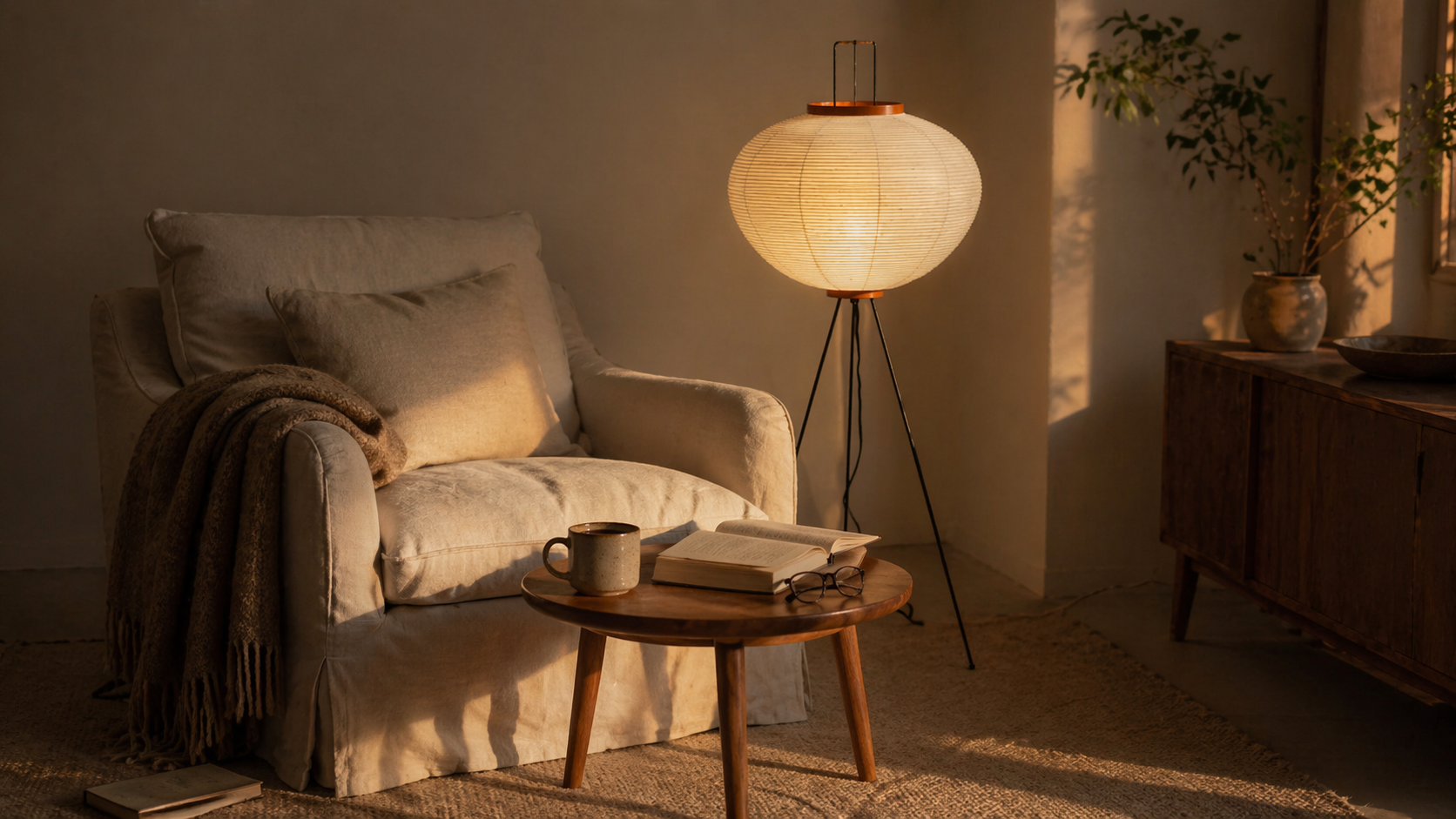
A diffused shade (linen, rice paper, opal glass) spreads light in all directions. The corner stays bright generally, the page gets less focused intensity, but the whole room reads warmer. Better for a corner that doubles as ambient light in a living room.
Pick based on what the corner does when nobody's reading there.
A floor lamp worth considering
Our Batalha floor lamp is a mulberry paper (washi) shade design that leans toward the diffused end. The light it casts is wider than focused, which makes it better suited to a corner that also functions as part of the living room than to a dedicated deep-reading chair. If your reading corner is the occasional kind, this is the lamp we reach for.
For a corner built around reading alone, look for something with a narrower shade and an open bottom. Browse floor lamps for the full selection.